
We have a new ANR JCJC project selected: V2XAntiJam (Dynamic Cooperative Anti-Jamming in 6G C-V2X Systems), coordinated by Pengwenlong Gu. The project will run from 2026 to 2030 under contract number ANR-25-CE25-6505.

The integration of automotive technology with information systems has seen significant advancements, driven by the need for enhanced road safety, optimised traffic management, and enriched infotainment services. Since its introduction in 2016 under 3GPP Release 13, Cellular Vehicle-to-Everything (C-V2X) has emerged as the premier and most comprehensive form of vehicular communication technology. C-V2X is poised to replace the Dedicated Short-Range Communications (DSRC), offering rich and reliable services to diverse road users [1]. Within C-V2X systems, besides the mature ad-hoc short-range communication techniques, wide-area cellular communication techniques are also supported that allow vehicles to communicate with other vehicles and roadside infrastructure. This dual approach enables communication with other vehicles and infrastructure across varying distances, significantly enhancing network reliability and scalability.
In the upcoming 6G era, 6G C-V2X systems are anticipated to revolutionise vehicular communication by offering ultra-wide coverage, achieving extra-low transmission latency, and introducing cutting-edge features. These include advanced AI-driven applications, as well as capabilities for remote operation and fully autonomous driving, thereby enhancing both the functionality and safety of transportation networks [2]. However, the integration of advanced features in modern communication systems necessitates more frequent interactions between users and infrastructure. This increased connectivity significantly raises the system’s complexity, thereby exacerbating the risks posed by availability threats such as radio frequency (RF) jamming [3] and hijacking attacks [4]. These threats are particularly perilous in sophisticated radio environments like those found in 6G C-V2X systems. Jamming attacks, for instance, are crafted to disrupt communications with minimal complexity and energy expenditure. Similarly, hijacking attacks function as a form of man-in-the-middle assault where attackers transmit signals that mimic legitimate ones, thereby intercepting or blocking genuine communication sessions. Therefore, the evolution of defense strategies for both RF jamming and hijacking can be efficiently integrated into one comprehensive anti-jamming framework. This unification not only streamlines the defense mechanisms by leveraging common technologies and methodologies but also fortifies the communication systems’ resilience against all forms of signal interference and unauthorized signal mimicry. In designing this framework, two primary challenges must be addressed:
• Attack detection in 6G C-V2X systems: The large cover range, high dynamic topology, and complex radio scenarios make jamming attack detection one major challenge in 6G C-V2X systems [5]. Although machine learning is considered a powerful tool [6], how to design an efficient but low-cost (including convergence speed and communication costs) learning model to adapt to dynamic physical and radio scenarios remains a major challenge. Especially in possible multiple cooperative jammers scenarios.
• Dynamic anti-jamming scheme design: In our earlier research, we demonstrated the effectiveness of anti-jamming strategies by leveraging spatial diversity through user cooperation [7][8], introduced a collaborative scheme to counteract constant control channel jamming in DSRC-based vehicular networks [9][10]. Moving forward to 6G C-V2X systems, we face the new challenge of managing a more intricate radio environment alongside more sophisticated jamming threats. Novel techniques, such as Intelligent Reflecting Surfaces (IRS) [11], offer promising enhancements to anti-jamming scheme designs. However, optimising these technologies to achieve an optimal balance between efficiency and cost continues to be a significant hurdle.
In the anti-jamming context, particularly within complex radio scenarios such as 6G V2X networks, understanding attack strategies, developing efficient detection methods, and implementing reliable countermeasures are critical to ensuring robust communication resilience. Complex environments amplify the sophistication of intelligent jamming attacks, such as adaptive frequency jamming or selective beam interference, which exploit system vulnerabilities to disrupt critical operations like autonomous driving. A deep understanding of these attack strategies enables the identification of exploitable signal patterns (e.g., RF fingerprints) and informs the design of targeted defenses, while efficient detection methods allow for rapid identification of threats amidst noise and interference, minimizing response latency in time-sensitive applications. And reliable countermeasures are essential to neutralize jamming effects and maintain service continuity, especially when traditional approaches falter under the unpredictability of real-world radio dynamics. Together, these elements form an integrated defense framework, indispensable for safeguarding next-generation wireless networks against evolving threats.
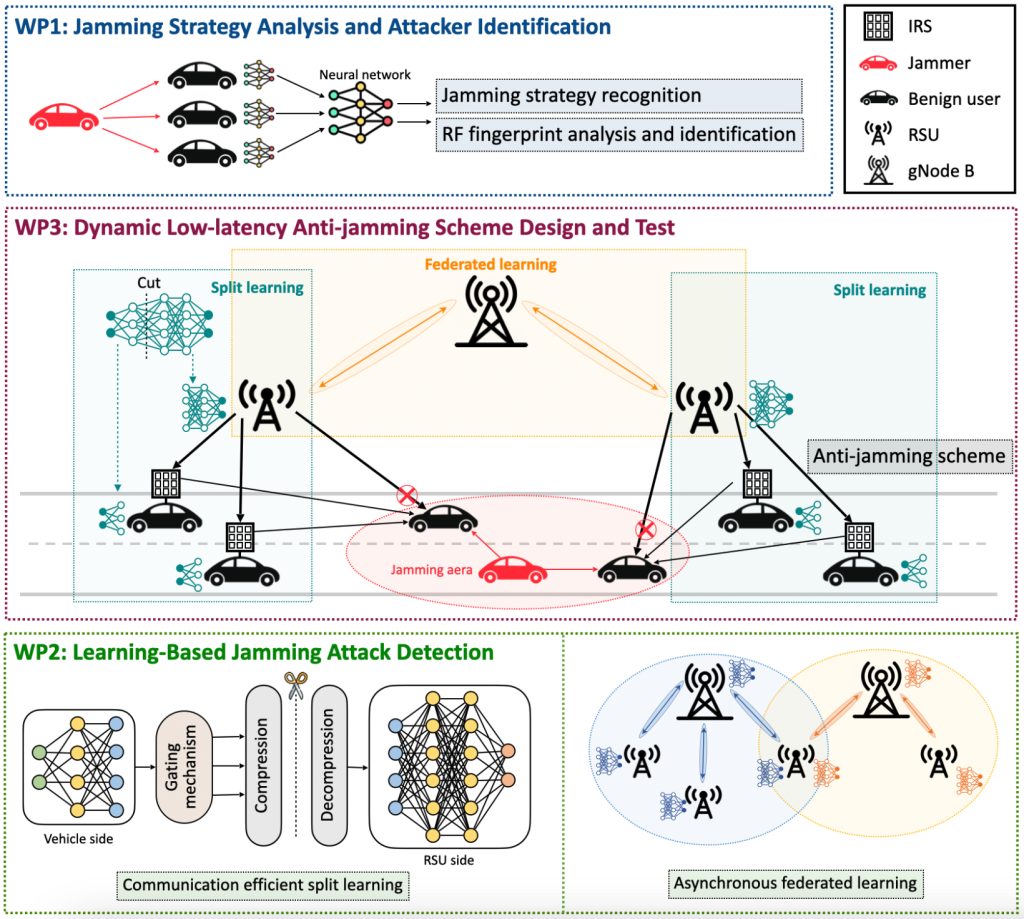
Objectives and scientific hypotheses
Objectives: The overarching objective of this project is to develop a robust, scalable, and efficient framework for securing 6G V2X networks against intelligent jamming attacks, leveraging RF fingerprinting, distributed learning, and anti-jamming techniques. Specifically, the project pursues the following goals across its three Work Packages:
• O1-Develop an effective feature-based detection method: Detection of jamming attacks poses a persistent challenge, particularly against intelligent attackers in large-scale, complex radio environments. To address this, we propose a feature-based detection method that meticulously captures key characteristics of intelligent jammers in 6G V2X networks, enhancing detection efficiency by incorporating innovative techniques such as RF fingerprinting to expand the range of identifiable features.
• O2-Minimize substantial learning costs: Machine learning techniques enhance attack detection accuracy in large-scale systems but often increase system complexity and communication overhead. To address this, we propose a distributed learning-based approach for near real-time attack detection in 6G V2X networks, minimizing learning and communication costs. By integrating split and federated learning with optimizations like bottleneck injection and asynchronous updates, our system improves communication efficiency and convergence speed while adapting to the dynamic 6G V2X environment.
• O3-Design and evaluate a cost-effective anti-jamming scheme: Designing anti-jamming schemes that leverage spatial diversity from multiple antennas is a well-established approach. In this project, building on an efficient jamming detection system, we propose a low-cost (proved in section I.b) anti-jamming solution using multiple IRSs to optimize signal quality during attacks. We will validate our methods through a 5G Open-RAN testbed, connecting theoretical innovations to practical deployment in real-world 6G V2X scenarios.
Collectively, these objectives aim to enhance the security and resilience of 6G V2X systems by combining advanced signal analysis, machine learning, and hardware-based solutions, ultimately enabling reliable communication for critical V2X applications.
Scientific Hypotheses: The project rests on several scientific hypotheses that underpin its methodological approach and expected outcomes: 1) Intelligent jamming attacks in 6G V2X networks exhibit distinct RF fingerprint signatures that can be reliably captured and localized using a multi-view analysis approach, despite environmental noise and interference. This assumes that hardware-specific imperfections in transmitters are sufficiently stable and unique to enable precise attacker identification across multiple receivers; 2) A hybrid local-federated learning framework can effectively detect and locate attacks in real time with minimal labeled data, and its communication efficiency can be significantly improved through dynamic bottleneck injection and asynchronous updates. This posits that distributed learning can adapt to the scale and variability of 6G V2X networks while maintaining accuracy and reducing overhead. 3) Multiple IRSs can cooperatively mitigate jamming effects by optimizing signal-to-interference-plus-noise ratio (SINR) at the receiver, and this theoretical optimization can be practically validated on a 5G Open-RAN testbed with performance closely aligning to simulations. This assumes that IRS phase adjustments can dynamically counteract jamming in a real-world setting, bridging the gap between theory and practice.