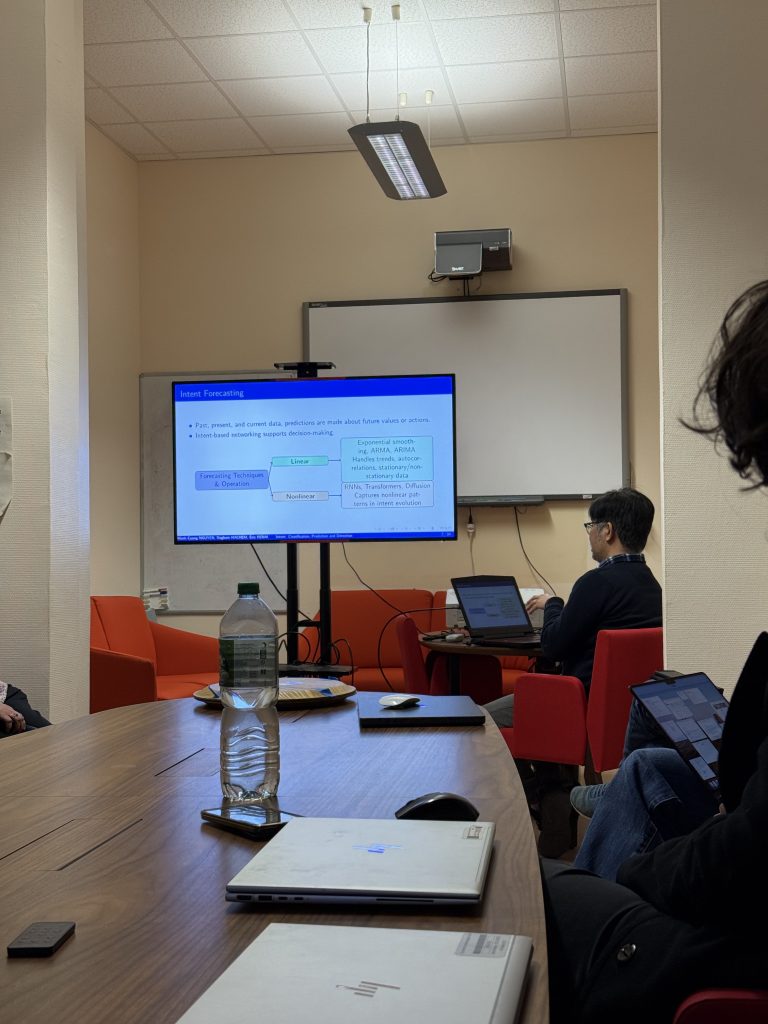
The ROC team is hosting a talk by Cuong Nguyen, Postdoctoral Researcher at LIGM/ESIEE & Morgane Joly, CTER at the University of Caen Normandy, SAFE team, GREYC Lab, France, and a new ROC Postdoctoral Researcher.
When: January 29, 2026 from 14h00 to 16h00
Where: Amphitheatre Gaston-Planté, Accès 35 – Level 1, 2 rue Conté, 75003 Paris, France.
Speaker: Cuong NGUYEN, LIGM/ESIEE, France

Title: Intent-Based Networking — From Proactive Forecasting to Malicious Intent Detection
Abstract: Intent-Based Networking (IBN) aims to revolutionize network administration by automating configurations based on high-level user objectives. However, achieving true self-optimization requires two critical capabilities: the ability to forecast future intent demands for proactive resource management and the ability to detect malicious intents that threaten security. This presentation details a comprehensive approach to both challenges.
Bio: After completing a PhD in 2015 focused on voice capacity optimization over 4G LTE networks for security services (Télécom SudParis), Cuong NGUYEN enhanced his profile with nearly eight years of significant experience in industrial R&D (AXA, LTU Tech, BNP Paribas Cardif). He specializes in applying Deep Learning methods (Computer Vision, OCR, LLM/RAG) to complex, large-scale problems. Currently a Postdoctoral Researcher at LIGM/ESIEE Paris, his research focuses on Intent-Based Networking (IBN).
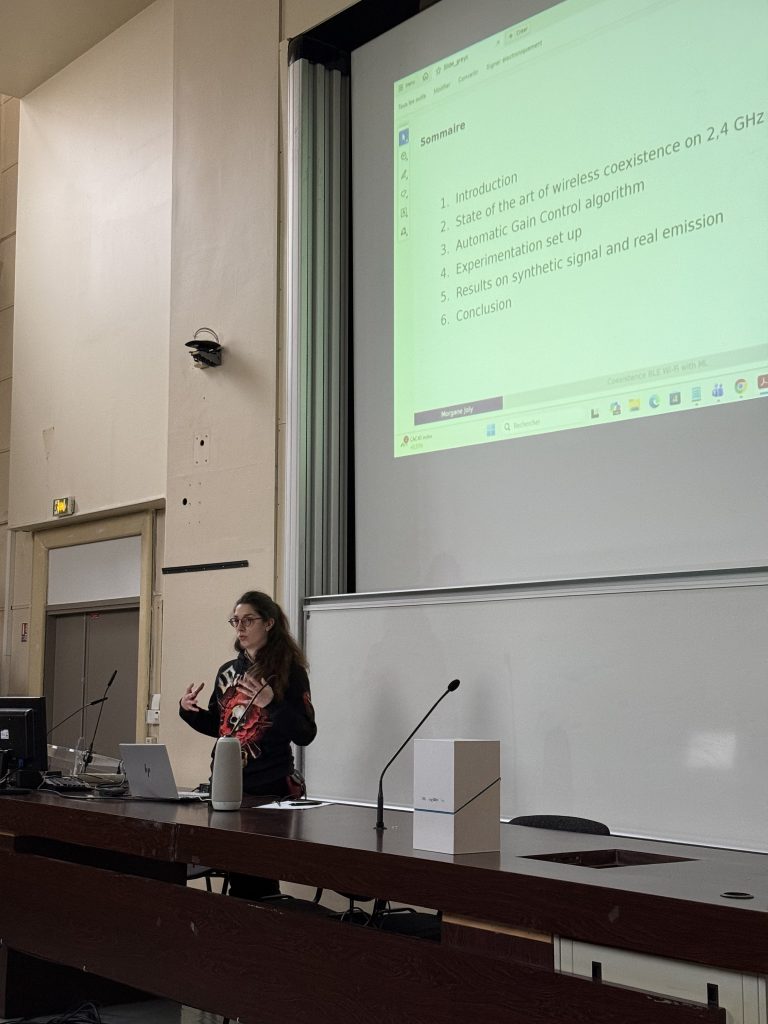
Speaker: Morgane Joly, U. of Caen Normandy – SAFE, GREYC Lab, France

Title: Contribution to the study of improving the radio coexistence of a wireless sensor network by implementing embedded algorithms based on artificial intelligence
Abstract: The ISM band is an unlicensed band where emission restrictions are relaxed compared with the licensed band. This has led to a proliferation of communication protocols (Wi-Fi, Bluetooth Low Energy (BLE), Zigbee, etc.), despite the absence of any guarantee of spectrum availability. While narrow-band, low-power protocols make it possible to optimise energy for short-range communications and ultimately extend the battery life of IoT devices, their methods of accessing the radio environment have limitations when it comes to guaranteeing good reception conditions in the event of high radio activity in the frequency band used.For this study we focused on improving the interference management of the BLE receiver. Its weaknesses are symptomatic of protocols optimised to be energy-efficient. Wi-Fi uses a relatively high level of power and broadband frequencies, compared to BLE, during transmissions, contributing significantly to BLE interference. We have specifically studied this problem with the case of late arrivals of interference in relation to the freezing of the gain index of the low-noise amplifier (LNA). This configuration is the most dammaging to the optimum compromise between linearity and receiver noise, which is supposed to be guaranteed by the convergence of the LNA gain. The setting up of our study is based on the following observation: due to the random nature of interference, collecting sufficient data on each channel to accurately predict interference on each channel requires very long simulation and measurement times. The type of data set produced in the end will lead to a large model with enormous computational requirements. This study presents the evaluation of several machine learning algorithms predicting the LNA gain index or the inability to receive the future packet, using a restricted history of receiver operating metrics and the output is the optimal Automatic Gain Control (AGC) index to be used for the reception of the next packet. As a result, we give the radio the ability to anticipate the appearance of an interferer during payload reception. The final evaluation of the system showed a significant improvement in the Packet Error Rate (PER). In particular, prediction of the AGC makes it possible to broaden the range of packets that can be received.
Bio: Morgane Joly is a CTER at University of Caen Normandy in the SAFE team at GREYC lab. After an engineering degree at ESIEE Paris, she studied the coexistence between Bluetooth Low Energy (BLE) and Wi-Fi through the use of Machine Learning (ML), for her thesis (CIFRE) in collaboration with NXP Semiconductor . Nowadays, she dedicates herself to the detection of malicious interferences in wireless low power protocols.
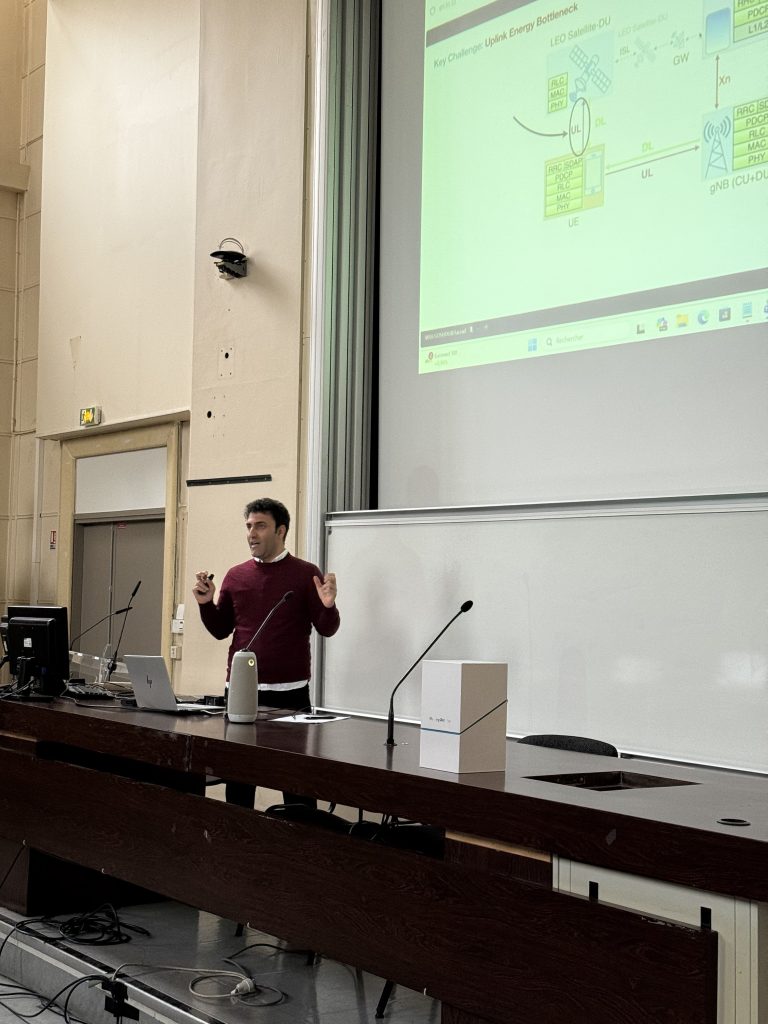
Speaker: Farzad Veisi Goshtasb, ROC Team, Cedric Lab
Title: Energy-Efficient Uplink-Downlink Decoupling for 6G TN-NTN Multi-Connectivity
Abstract: In 6G, LEO satellites complement terrestrial networks by extending coverage and offloading downlink services. However, direct satellite access faces a severe uplink energy bottleneck: required transmit power far exceeds handheld device capabilities. We propose decoupling uplink and downlink associations: uplink via short-range infrastructure (TN, UAV, HAPS)and downlink via satellite. Using 3GPP-compliant link budget analysis, we quantify substantial uplink power gaps and demonstrate order-of-magnitude battery lifetime extension with over 90% energy savings versus satellite-only operation. We address protocol feasibility through disaggregated RAN that eliminates inter-BS HARQ coordination overhead, and evaluate adaptive HARQ strategies (HARQ-less, independent, bundled). Results show bundled HARQ achieves substantial power reduction while maintaining high reliability with minimal delay overhead.
Bio: Farzad Veisi Goshtasb is a postdoctoral researcher at CNAM and the CedricLab in Paris. He received his M.Sc. degree in telecommunications engineering from Isfahan University of Technology, Isfahan, Iran, in 2019, and his Ph.D.in computer science from the University of Strasbourg, France, in 2023.His research interests primarily focus on wireless communication, Internet of Things, and software-defined networks
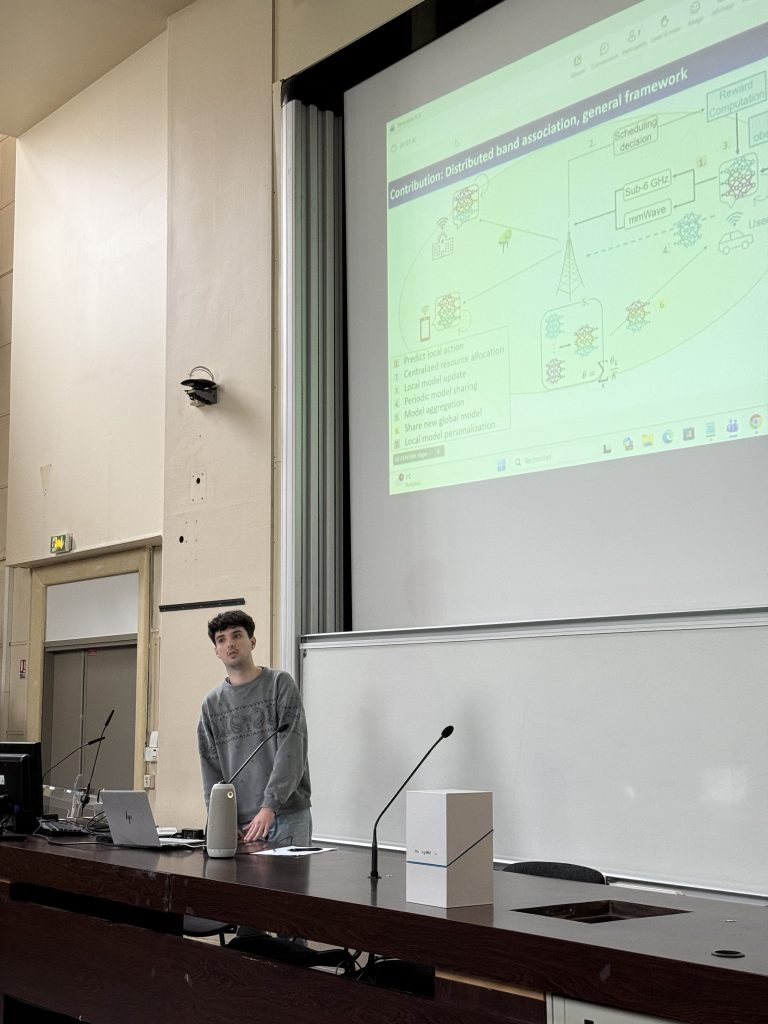
Speaker: Hugo De Oliveira, ROC Team, Cedric Lab
Title: Personalized Federated Learning for Resource Allocation in Dynamic and Heterogeneous IoT Network
Abstract: With the ever increasing number of Internet-of-Things (IoT) devices, meeting future requirements of Beyond 5G (B5G) applications is extremely challenging. In the context of IoT Short-Packet Communications (SPC), we investigate the frequency band association and resource allocation problems to maximize the global sum-rate objective under individual Quality-of-Service (QoS) requirements. Focusing on a Sub-6GHz/mmWave integrated network, we propose a distributed framework that enables each device to optimize its band association through a cooperative process based on Federated Multi-Agent Deep Reinforcement Learning (F-MADRL). To tackle the heterogeneity among devices, personalized Federated Learning (FL) techniques are explored to balance independence and cooperation. The numerical results show that our methods outperform DRL-based benchmarks, owing to their high adaptability to network dynamics, such as blockage variations and user mobility.
Bio: De Oliveira Hugo received the bachelor’s and master’s degrees in computer science from Paris-Saclay University, France, in 2020 and 2022, respectively. He received the Ph.D. degree in 2025 under a joint international program (cotutelle) between Paris-Saclay University, France, and the Graduate University for Advanced Studies (SOKENDAI), Japan. His research interests include wireless communications, IoT networks, machine learning methods for wireless systems, and optimization problems.