
In our next ROC seminar, the PhD students will present their current work on Tuesday, 18 November 2025, from 14:00 to 16:00.
Seminar Location: Amphitheatre Aimé-Laussedat, Accès 31 – Level 3, 2 rue Conté, 75003 Paris, France
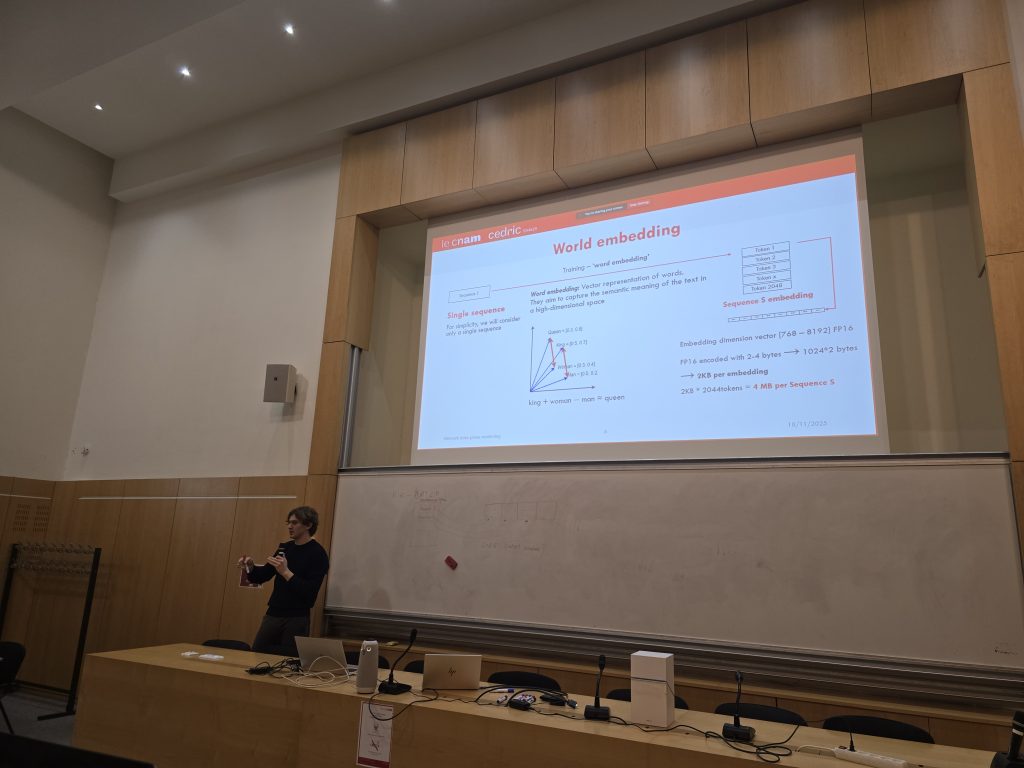
Speaker: Davide Avesani
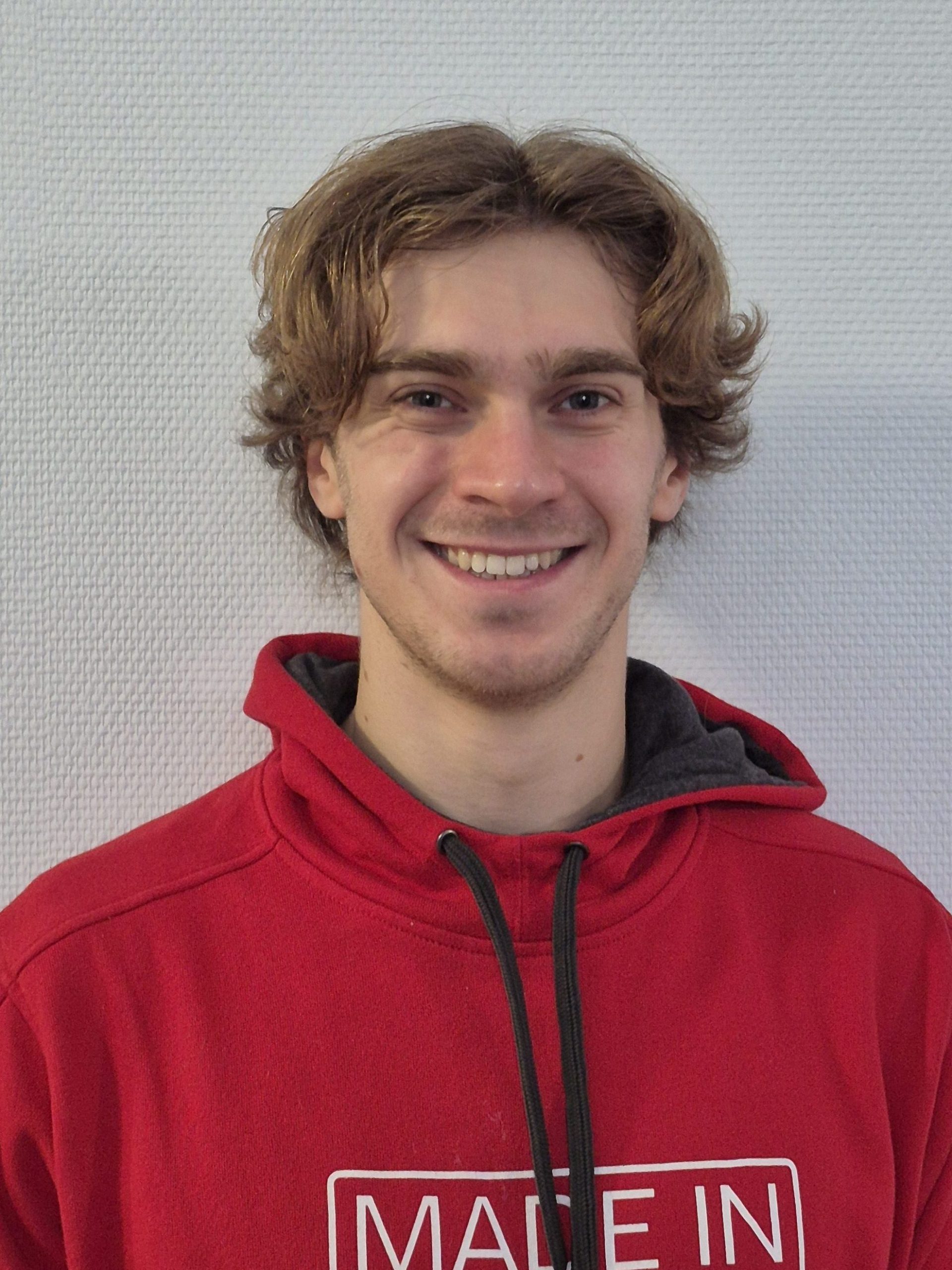
Title: The Journey of a Token
Abstract: The paper “Attention Is All You Need” introduced a new artificial neural network architecture called the transformer, which became the foundation of today’s large language models (LLMs). Since then, research has shown a clear pattern: larger models (which size is measured in number of trainable parameters) and bigger training datasets usually lead to better performance. As a result, we now have models with up to trillions of parameters and training data sets of the size of petabytes. Training these large models requires specialized hardware, typically consisting of thousands of GPUs or TPUs interconnected via high-performance infrastructure. To maintain synchronization and keep the training process up to date, these computing units need to exchange large volumes of data at high rate. A key objective of the infrastructure is to maximize GPU utilization by minimizing communication time thus mitigating delays introduced by communication overhead. Before exploring methods for optimizing communication, it is essential to understand how data to be exchanged is generated, estimate its volume, and determine its path through the network in order to characterize it correctly. This poses a major challenge due to the many interacting variables and parameters involved in distributed training of LLMs. “The Journey of a Token” seeks to demystify the communication process by tracing the path of a single token through the distributed training pipeline of LLMs, from its generation to its contribution to the model’s output. Through this work, we aim to address fundamental questions regarding message data generation, shared data size estimation, and network traversal, providing a foundation for better understanding and optimizing communication dynamics in large-scale model training.
Bio: Davide Avesani holds a master’s degree in Computer Science and Engineering from “La Sapienza University of Rome”. He partnered with ISEP – Paris School of Engineering on his master’s thesis, which focused on evaluating and improving the use of LLMs to detect hate speech in social media comments. His paper, titled “Detecting Hate Speech Against People with Disabilities in Social Media Comments Using Rag-enhanced LLMs, Fine-tuning, and Prompt Engineering” will be presented at IEEE FLLM 2025 conference in Vienna, Austria on November 25. His current research focuses on network optimization for generative AI as part of the Net4AI project. Specifically, he is focused on understanding and characterizing data transmission within and across data centers during the inference and training of LLMs.
Speaker: Clément Duchesne

Title: Dynamic adaptation of 5G core networks for security
Abstract: The 5G core network is the backbone of modern mobile communication, providing high-speed, low-latency, and diverse services for users and industries. Artificial Intelligence (AI) plays an important role in this network by optimizing performance, supporting dynamic resource scaling, and improving security through anomaly detection and threat mitigation. Testing AI in 5G environments is difficult due to the network’s complexity and the many potential attack vectors. We present a modular and reproducible testbed for evaluating AI-based security mechanisms in the 5G core. The testbed emulates key 5G components and generates datasets, including multiple categories of attacks, enabling machine learning-based anomaly detection and benchmarking. It also provides reliable measurements of Key Performance Indicators (KPIs) to evaluate the effectiveness, robustness, and operational
impact of AI solutions, including their ability to detect and mitigate threats. Finally, we outline AI-driven mitigation strategies, leveraging reinforcement learning to enable adaptive response mechanisms that can learn from network interactions and evolving threats. Our work aims to support the advancement of resilient security mechanisms for next-generation mobile networks.
Bio: Clément Duchesne received his Engineering degree from ESME Sudria Paris in 2024. He completed his end-of-studies internship at Thales, where he focused on analyzing the security of the 5G Core network. His paper “An AI Security Testbed for the 5G Core” will be presented at the IEEE CloudCom 2025 Conference in Shenzhen, China on november 15. He is currently pursuing a Ph.D. jointly between Thales and the Conservatoire National des Arts et Métiers (CNAM). His research focuses on the dynamic adaptation of networks to enhance security and resilience.