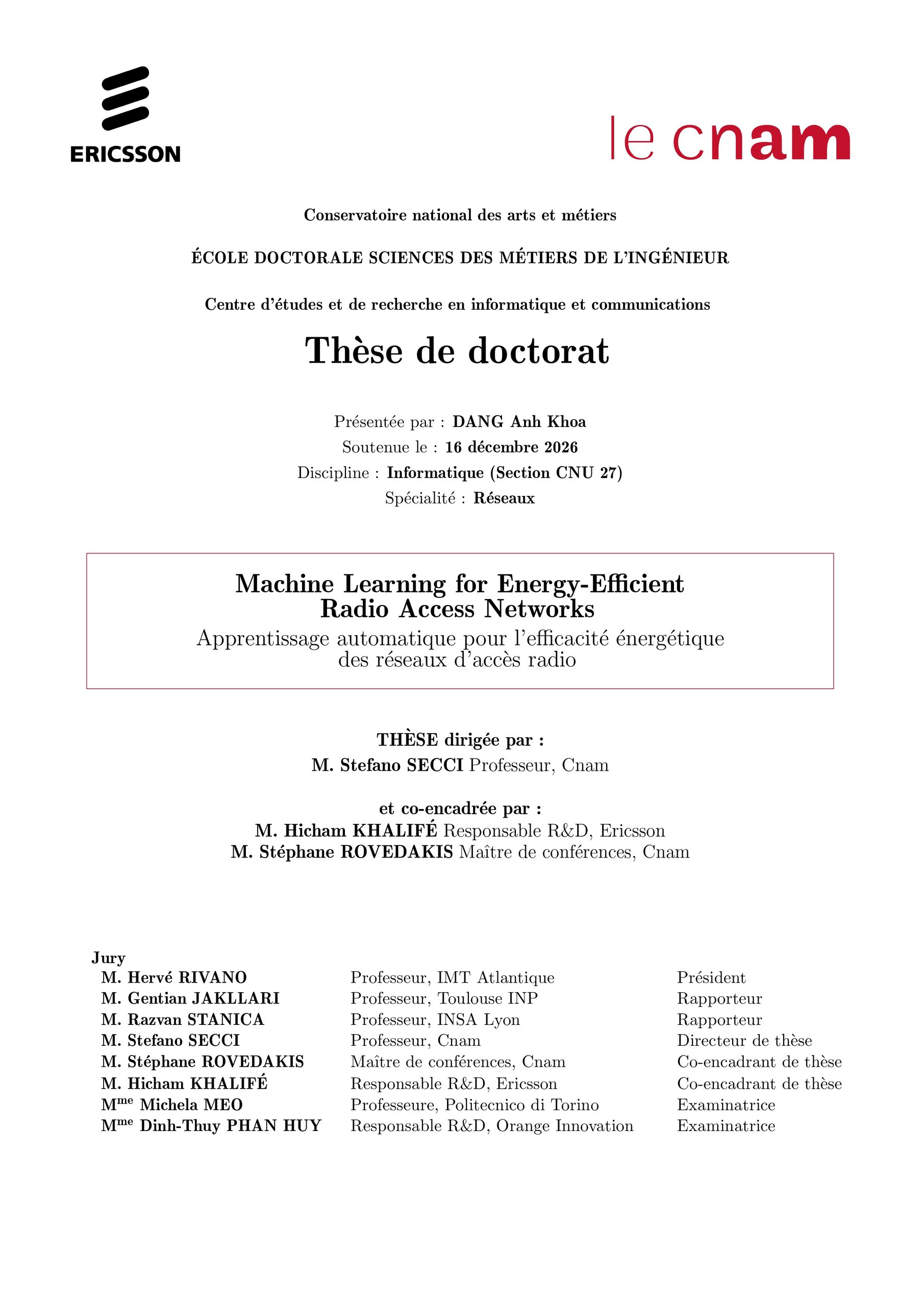
Anh-Khoa Dang, industrial Ph.D. student in collaboration with Ericsson, will defend his Ph.D. thesis on December 16, 2026, at 1:30 p.m, in the “Boris Vian” Thesis Room (37.2.43) at Cnam, 2 rue Conté, 75003 Paris, France.
Thesis Title: Machine Learning for Energy-Efficient Radio Access Networks
Thesis Title (French): Apprentissage automatique pour l’efficacité énergétique des réseaux d’accès radio
Abstract:
Energy performance has emerged as a critical design objective for future mobile networks, driven by economic and environmental concerns. At the same time, continuously growing mobile traffic requires networks to provide increasing capacity and performance. These conflicting objectives create a key challenge of accommodating rising traffic demand while limiting the associated increase in energy consumption. Since mobile traffic varies considerably throughout the day, radio resources dimensioned for high-demand periods can become underutilized when traffic decreases. This creates opportunities to reduce energy consumption by adapting the active radio resources to variations in daily traffic demand. In this thesis, intelligent energy-saving approaches are developed for Radio Access Networks (RAN) to exploit these opportunities while preserving service availability and network performance. In the first part, intelligent energy saving is investigated under a coverage preservation objective, where radio resources can be deactivated only if traffic demand can be served by the remaining active resources. First, a deep reinforcement learning (DRL) framework is developed for small base station (BS) sleep control in a two-tier heterogeneous network (HetNet), where small BSs provide additional capacity under macro BS coverage. Then, the investigation is extended to a sector-based multi-band cellular network, where each macro BS comprises multiple sectors and each sector operates several co-located frequency carriers. Probabilistic traffic forecasts are used to keep only the necessary carriers operational according to the expected demand. This progression moves from small BS sleep control to finer-grained adaptation across multiple frequency carriers within each sector of macro BS. In the second part, energy saving in multi-band cellular networks is investigated under explicit user experience requirements in addition to coverage preservation. First, a data-driven modeling framework is developed from offline network measurements for joint carrier shutdown and user reallocation, where DRL optimizes the control decisions and a supervised learning model predicts the resulting user experience. The study then shifts to system-level network simulation, where radio propagation and user throughput are explicitly modeled. Building on this setting, carrier priority is introduced as a unified control mechanism for traffic steering and carrier deactivation, with DRL used to adapt the priorities to traffic variations. Finally, the scope of our RAN energy modeling is then further broadened to carrier-level transmission power adaptation through a scalable multi-agent DRL framework that coordinates decisions across neighboring network entities. Overall, this thesis demonstrates that machine learning can effectively improve RAN energy performance and establishes the importance of jointly optimizing energy-saving control and traffic steering to minimize energy consumption while satisfying network performance requirements, paving the way toward more autonomous and energy-efficient future mobile networks.
Anh-Khoa‘s publications:

Journal articles
- Anh-Khoa Dang, Hicham Khalife, Mathias Sintorn, Stephane Rovedakis, Stefano Secci. Data-driven Carrier Shutdown for Energy-Efficient Mobile Networks with User Experience Guarantees. IEEE Transactions on Mobile Computing, In press, pp.1-17. ⟨10.1109/TMC.2026.3731024⟩. ⟨hal-05757216⟩
- Nguyen Huu Thanh, Nguyen Ngoc Tuan, Dang Anh Khoa, Le Cong Tuan, Nguyen Trung Kien, et al.. On Profiling, Benchmarking and Behavioral Analysis of SDN Architecture Under DDoS Attacks. Journal of Network and Systems Management, 2023, 31 (2), pp.43. ⟨10.1007/s10922-023-09732-5⟩. ⟨hal-05040258⟩
Conference papers
- Alexandros Kouvatseas, Anh-Khoa Dang. Energy-Efficient Antenna Muting in Massive MIMO Networks Using Deep Reinforcement Learning. 2026 IFIP Networking Conference (IFIP Networking), May 2026, Lugano, France. pp.1-6, ⟨10.23919/IFIPNetworking70592.2026.11579257⟩. ⟨hal-05676857⟩
- Anh-Khoa Dang, Hicham Khalifé, Stéphane Rovedakis, Stefano Secci, Maxime Bouton, et al.. Carrier Priority Control for Energy-Efficient Multi-Band Networks: A DRL-Based Approach. 2026 IFIP Networking Conference (IFIP Networking), May 2026, Lugano, Switzerland. pp.1-9, ⟨10.23919/IFIPNetworking70592.2026.11579169⟩. ⟨hal-05596008⟩
- Anh-Khoa Dang, Hicham Khalifé, Stéphane Rovedakis, Stefano Secci, Mathias Sintorn. Energy Optimization for Multi-Band Cellular Networks: A Traffic Prediction-Based Strategy. 2025 IEEE International Conference on Machine Learning for Communication and Networking (ICMLCN), May 2025, Barcelona, Spain. pp.1-6, ⟨10.1109/ICMLCN64995.2025.11140086⟩. ⟨hal-05040262⟩
- Anh-Khoa Dang, Hicham Khalifé, Mathias Sintorn, Stephane Rovedakis, Stefano Secci. Data-driven Energy Optimization in Mobile Networks with User Experience Guarantees. IEEE INFOCOM 2025 - IEEE Conference on Computer Communications, May 2025, London, United Kingdom. ⟨10.1109/INFOCOM55648.2025.11044545⟩. ⟨hal-05040259⟩
- Khoa Dang, Hicham Khalifé, Mathias Sintorn, Dag Lindbo, Stefano Secci. Deep Reinforcement Learning for Joint Energy Saving and Traffic Handling in xG RAN. ICC 2024 - IEEE International Conference on Communications, Jun 2024, Denver (CO), United States. pp.4743-4748, ⟨10.1109/ICC51166.2024.10622652⟩. ⟨hal-04612869⟩
Powered by HAL