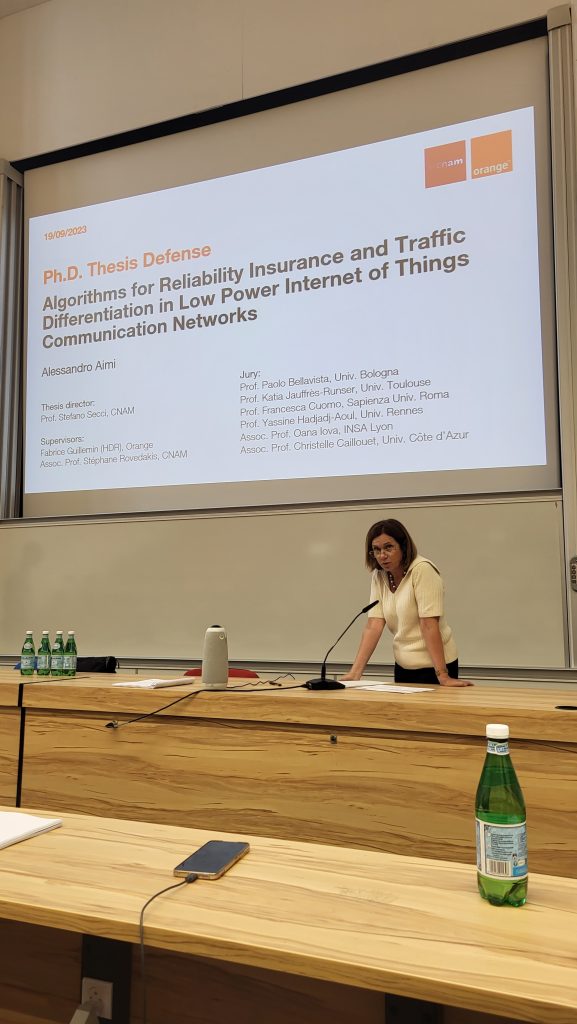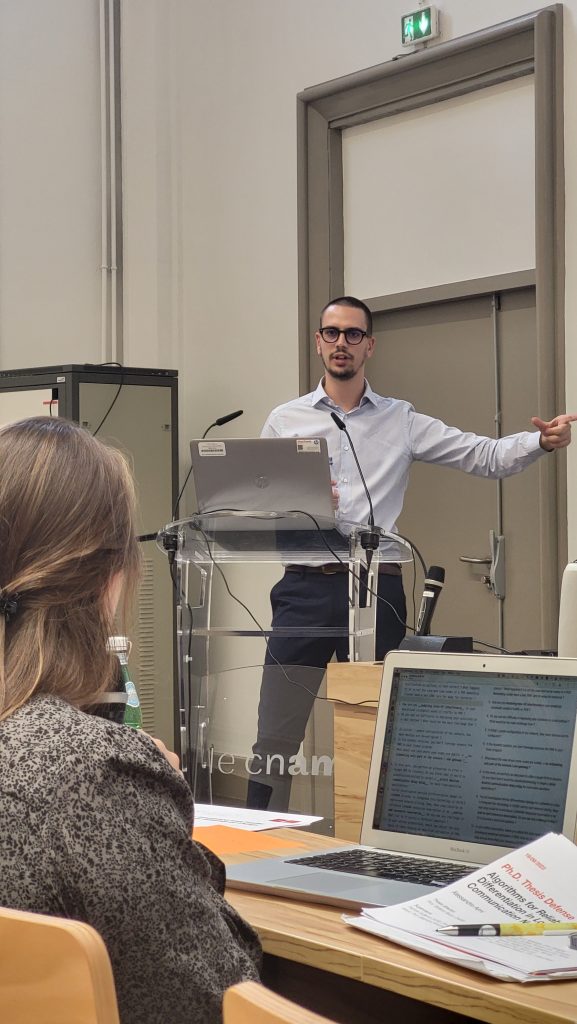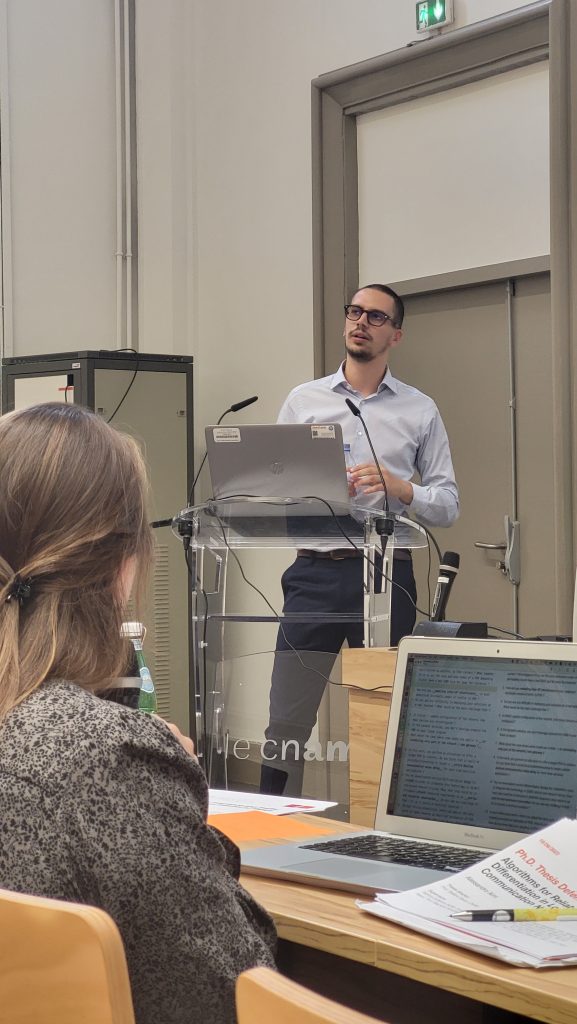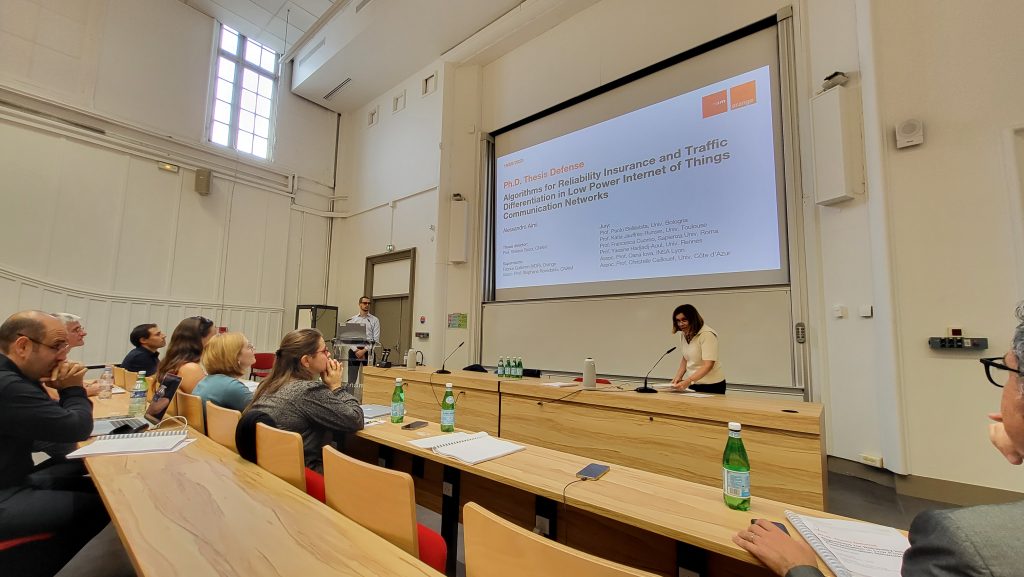
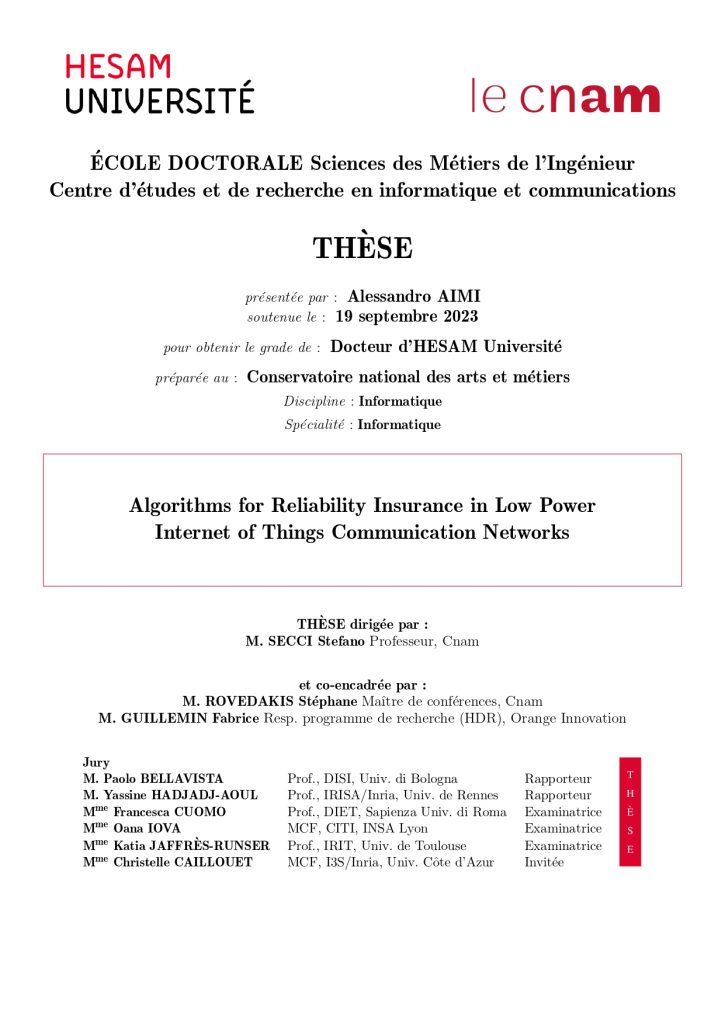
Alessandro Aimi, industrial Ph.D. student in collaboration with Orange Labs, will defend his Ph.D. thesis on September 19, 2023, at 1:30 p.m, in the Amphitheatre Georges Friedmann at Cnam, 2 rue Conté, 75003 Paris, France.
Alessandro worked on the integration of LoRaWAN in a network slicing and zero-touch management framework. He will work as postdoc at University of Bologna right after the defence.
Thesis Title: Algorithms for reliability insurance and traffic differentiation in low power internet of things communication networks
Thesis Title (French): Algorithmes pour l’Assurance de la Fiabilité et la Différenciation du Trafic dans les Réseaux de Communication de l’Internet des Objets à Faible Consommation d’Énergie
Abstract:
The ever-growing presence of the Internet of Things (IoT), characterized by a plethora of independent technologies at the network edge, calls for a seamless integration in the context of beyond 5G transformations. Novel principles and technologies such as softwarization and virtualization, multi-access edge computing, and artificial intelligence pave the way for the broader paradigms of network slicing and zero-touch management.On the one hand, network slicing postulates the partition of networks into either partially or fully isolated horizontal slices for on-demand offering of specific services with guaranteed Service Level Agreements (SLAs). On the other hand, zero-touch management proposes achieving full automation with the introduction of smart loops for all support and maintenance operations to maintain SLAs.Among the IoT technologies, Long Range Wide Area Networks (LoRaWANs) are rapidly gaining popularity thanks to their cheap and easy-to-operate nature. LoRaWAN is a low power wide area network technology targeting long range sensing and monitoring. Use cases are typically in the domain of agriculture (cattle tracking, soil properties monitoring) and smart cities (bicycle pool management, garbage monitoring, air quality monitoring, etc.)One of the design choices in LoRaWAN is the uncoordinated access to the radio medium. This aims to minimize the power consumption of intermittently active devices by simplifying the communication protocol stack. Consequently, collisions are frequent in dense deployments, resulting in best effort operation, inherently inefficient utilization of resources and lack of quality. A key performance metric for an application using LoRaWAN is the Packet Delivery Ratio (PDR).In this thesis we consider open issues regarding the integration of LoRaWAN in a network slicing and zero-touch management framework. LoRaWAN introduces several challenges in the radio access network: limited action in partitioning radio resources, sparse device control opportunities, and no realistic requirement specification that can be integrated in SLAs to enable network slicing. In our contributions, we first investigate the introduction of PDR-based traffic quality differentiation in LoRaWAN, showing its feasibility and potential appeal in dense scenarios. Based on our findings, we proceed to improve our resource allocation with an online technique for PDR management which is both adaptive to changes and drastically more efficient. Finally, we capitalize on our extensive simulation efforts to produce an open-source tool to enable high-fidelity, end-to-end emulation of massive-IoT LoRaWAN services on real-world infrastructures.
Alessandro’s publications:

Conference papers
- Alessandro Aimi, Stephane Rovedakis, Fabrice Guillemin, Stefano Secci. ELoRa: End-to-end Emulation of Massive IoT LoRaWAN Infrastructures. 2023 IEEE/IFIP Network Operations and Management Symposium (NOMS), May 2023, Miami, FL, United States. ⟨hal-04025834⟩
- Alessandro Aimi, Fabrice Guillemin, Stephane Rovedakis, Stefano Secci. Packet Delivery Ratio Guarantees for Differentiated LoRaWAN Services. IEEE Global Communications Conference (GLOBECOM), Dec 2022, Rio de Janeiro, Brazil. ⟨hal-03654692v2⟩
- Alessandro Aimi, Fabrice Guillemin, Stéphane Rovedakis, Stefano Secci. Traffic Control and Channel Assignment for Quality Differentiation in Dense Urban LoRaWANs. 2022 20th International Symposium on Modeling and Optimization in Mobile, Ad hoc, and Wireless Networks (WiOpt), Sep 2022, Turin, Italy. pp.153-160, ⟨10.23919/WiOpt56218.2022.9930551⟩. ⟨hal-03725988⟩
Reports
- Alessandro Aimi, Stephane Rovedakis. E2E demonstrator definition describing all network elements and modules. Conservatoire national des arts et metiers - CNAM. 2025. ⟨hal-05091083⟩
- Renzo E. Navas, Alessandro Aimi. Software repository: Automation framework software. Irisa Institut de Recherche en Informatique et Systèmes Aléatoires; Conservatoire national des arts et metiers - CNAM. 2025. ⟨hal-05091094⟩
- Fabrice Guillemin, Alessandro Aimi, Tanguy Kerdoncuff, Stephane Rovedakis. Reference architecture for slicing in LoRAWAN networks (updated version). [Technical Report] Orange Labs. 2022. ⟨hal-03826493⟩
- Fabrice Guillemin, Renzo Navas, Alessandro Aimi, Tatiana Aubonnet, Tan- Guy Kerdoncuff, et al.. Reference architecture for slicing in LoRAWAN networks. [Research Report] Consortium INTELLIGENTSIA. 2021, pp.1-45. ⟨hal-03566398⟩
Theses
- Alessandro Aimi. Algorithms for Reliability Insurance and Traffic Differentiation in Low Power Internet of Things Communication Networks. Data Structures and Algorithms [cs.DS]. HESAM Université, 2023. English. ⟨NNT : 2023HESAC015⟩. ⟨tel-04235156⟩
Powered by HAL 
Access Thesis: https://theses.fr/2023HESAC015